

EXPERT LECTURE 2026-2027
Expert lecture on “Hardware Security and Cryptography for Secure VLSI Systems
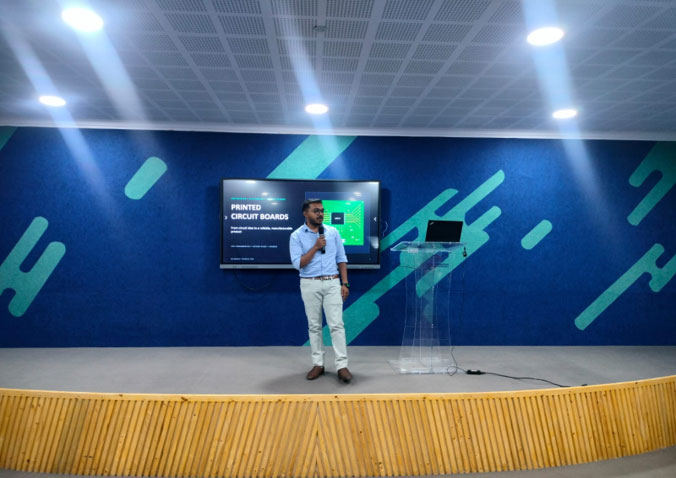
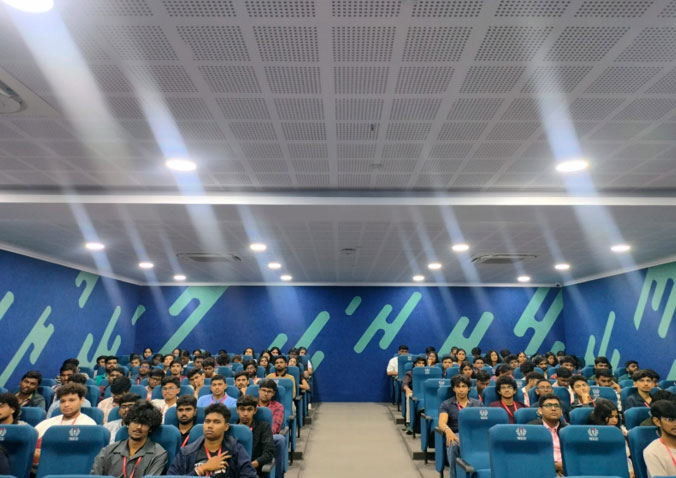
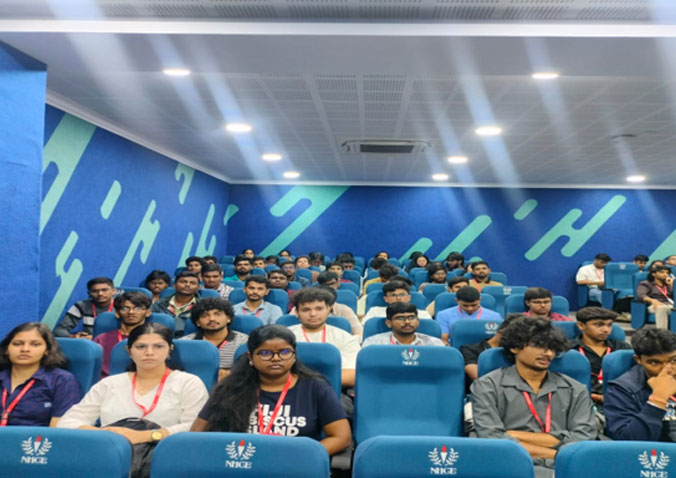
The Department of Electronics and Communication Engineering, New Horizon College of Engineering, in association with the IEEE NHCE Student Branch, the IEEE Circuits and Systems Society NHCE Student Branch Chapter and the IEEE Sensors Council NHCE Student Branch Chapter, organised a guest lecture titled “Inside the Board: The Engineering Behind PCB Design” on 13th November 2026 from 9:30 AM to 11:30 AM at the MBA Seminar Hall, NHCE. The session was conducted for third-semester students, and 101 students attended. The programme was convened by Dr. Manju Devi, Professor and Head of the Department, with Prof. Vinay R as the Faculty Coordinator.
The session was delivered by Mr. R. Rajatha, Product Design and Development Engineer, Aariv Technologies, Bengaluru. Drawing on his industry experience, the resource person highlighted the growing importance of Printed Circuit Board (PCB) design in the electronics industry and its role in modern product development, in line with current industry trends.
The speaker explained how PCB development begins with a schematic, a logical map of how components such as resistors, capacitors, microcontrollers and connectors relate to one another, and progresses to the physical board layout using Electronic Design Automation (EDA) tools. Students were introduced to industry-standard platforms such as KiCad, Altium Designer and Cadence Allegro. The lecture covered board materials such as FR-4 laminate and copper layers, multilayer stack-ups ranging from two to more than thirty layers, and the significance of component placement for signal paths, thermal management and manufacturability. Key concepts such as routing, copper traces, vias, matching trace width to current, and spacing rules to prevent short circuits and crosstalk were explained with practical relevance.
Students gained valuable insights into how design decisions directly influence circuit performance, reliability and production efficiency. The session bridged the gap between theoretical knowledge and real-world engineering practice in the electronics industry. An interactive discussion enabled students to clarify their doubts and better understand current industry requirements and career opportunities in PCB design.